
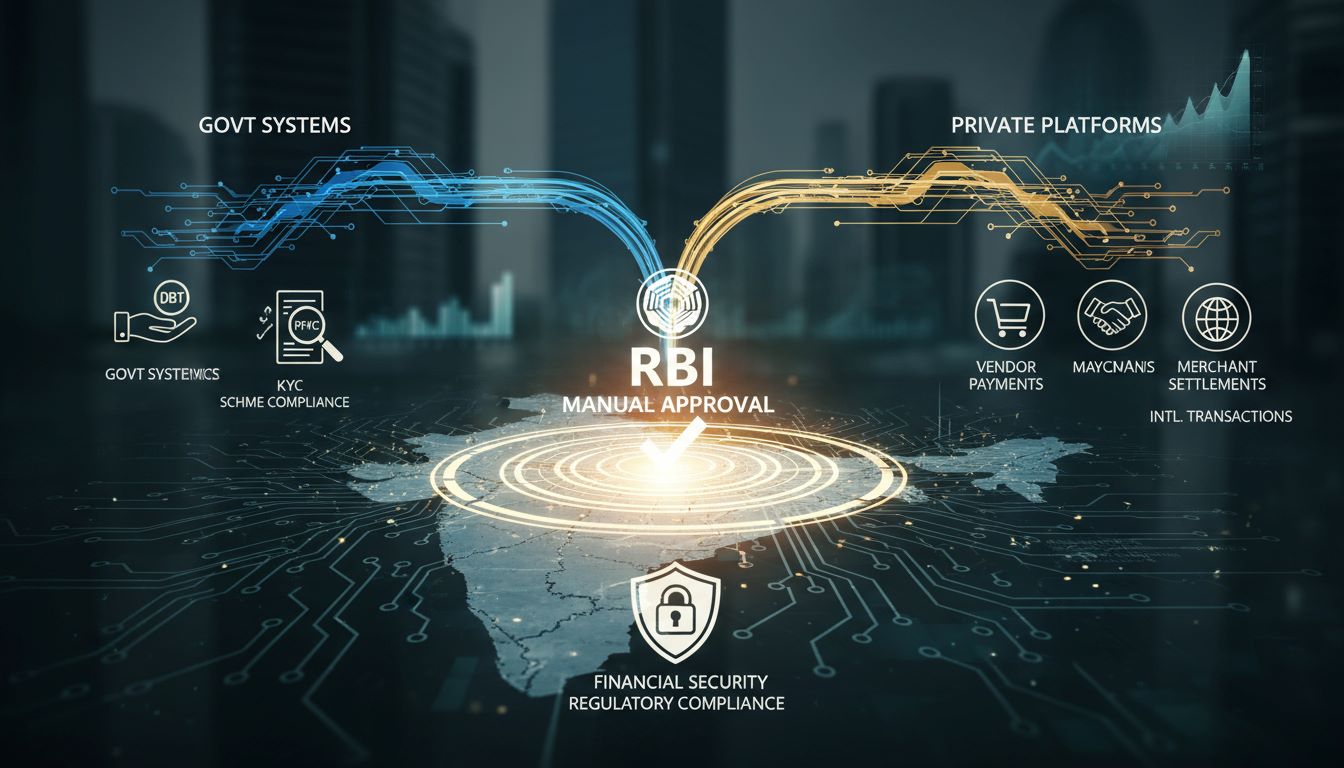
Manual payout approval in India represents a critical layer of financial security and regulatory compliance that protects both institutions and beneficiaries. The Reserve Bank of India (RBI) mandates these approval processes to ensure proper KYC validation, prevent fraudulent transactions, and maintain transparency in financial operations. These manual interventions become necessary when automated systems cannot verify transaction authenticity or when specific regulatory thresholds are exceeded.
The approval landscape differs significantly between government systems like Direct Benefit Transfer (DBT) and Public Financial Management System (PFMS), versus private platforms handling vendor payments, merchant settlements, and international transactions. Government processes prioritize beneficiary verification and scheme compliance, while private platforms focus on risk assessment and commercial validation. Understanding these distinctions is essential for navigating India’s complex payout ecosystem effectively.
Overview of Manual Payout Approval in India
Manual payout approval systems in India operate across multiple platforms, each with distinct requirements and processing timelines. Government platforms like PFMS prioritize beneficiary authentication and scheme eligibility, requiring extensive documentation for social welfare and subsidy distributions. Private platforms focus on merchant verification, transaction limits, and risk assessment protocols.
The regulatory framework mandates different approval stages depending on transaction type, amount, and recipient category. High-value transactions, international payouts, and first-time beneficiaries typically require additional verification layers. Security protocols ensure that all manual approvals maintain detailed audit trails and multi-level authorization.
Processing timelines vary considerably between platforms, with government systems often requiring 3-7 business days for complete approval cycles. Private platforms may process routine approvals within 1-2 business days, though complex cases involving compliance checks can extend significantly longer.
| Approval Stage | Platform/Govt | Documentation Required | Timelines |
|---|---|---|---|
| Initial Submission | PFMS/DBT | Aadhaar, Bank Details, Scheme ID | 1-2 days |
| KYC Verification | Private Platforms | ID Proof, Address Proof, Bank Statement | 2-3 days |
| Compliance Review | Banking Systems | Transaction History, Risk Assessment | 1-4 days |
| Final Authorization | All Platforms | Approval Signatures, Audit Trail | 1-2 days |
| International Clearance | FEMA Compliance | FIRC, Export Documents, Tax Certificates | 5-10 days |
Key Regulatory and Compliance Principles
RBI’s regulatory framework establishes comprehensive guidelines that govern manual payout approval processes across India’s financial ecosystem. These regulations ensure systematic risk management and transaction transparency while protecting both financial institutions and end users from potential fraud or compliance violations.
- KYC Compliance Standards: All payout requests must undergo mandatory Know Your Customer verification, including Aadhaar authentication, bank account validation, and beneficiary identity confirmation through government databases.
- Transaction Limit Protocols: E-mandate caps and daily transaction limits trigger automatic manual review processes, with amounts exceeding ₹1 lakh requiring additional authorization layers and enhanced documentation.
- Maker-Checker Authorization: Dual approval systems mandate that transaction initiators and approvers must be different individuals, ensuring independent verification and reducing single-point failure risks.
- Audit Trail Requirements: Every manual approval must maintain comprehensive digital records, including timestamps, approver identification, reason codes, and supporting document references for regulatory compliance.
- Anti-Money Laundering (AML) Checks: Suspicious transaction monitoring systems automatically flag unusual patterns, requiring manual investigation and approval before processing high-risk payouts.
Common Use Cases for Manual Approval
Manual payout approval becomes necessary in several specific scenarios where automated systems cannot adequately assess transaction legitimacy or compliance requirements. These situations typically involve either regulatory thresholds, data mismatches, or special operational circumstances that require human intervention.
Transaction amount limits frequently trigger manual reviews, particularly when single transactions exceed preset thresholds or when cumulative daily amounts surpass regulatory caps. Government benefit programs often implement additional checks for first-time beneficiaries or when payment amounts deviate from established patterns.
Compliance mismatches occur when beneficiary information doesn’t align perfectly with database records, requiring manual verification to resolve discrepancies. International transactions invariably require manual approval due to FEMA regulations and foreign exchange compliance requirements.
Special operational setups, such as bulk vendor payments, emergency disbursements, or system recovery processes following technical failures, also necessitate manual oversight to ensure proper authorization and documentation before processing proceeds.
Step-by-Step: Requesting Manual Payout Approval
The manual payout approval process follows a structured workflow designed to ensure comprehensive verification while maintaining reasonable processing timelines. Understanding each step helps organizations prepare proper documentation and set appropriate expectations for approval timelines.
Initial request submission requires accessing the appropriate portal system, whether PFMS for government payments, banking platforms for commercial transactions, or specialized vendor management systems. Proper portal selection is crucial as different systems have varying documentation requirements and processing protocols.
- Portal Access and Login: Access the designated payment platform using authorized credentials, ensuring proper user permissions for manual approval requests and transaction submission capabilities.
- Beneficiary Information Entry: Input complete beneficiary details including full name, bank account number, IFSC code, mobile number, and any required scheme or vendor identification numbers.
- Document Upload Process: Attach all mandatory supporting documents in specified formats, including identity proofs, bank statements, authorization letters, and any scheme-specific documentation requirements.
- Transaction Details Specification: Enter precise payment amounts, purpose codes, reference numbers, and any special instructions while ensuring alignment with approved budgets or contracts.
- Internal Review Submission: Submit the request for internal organizational review, where designated approvers verify information accuracy and compliance with internal policies before external submission.
- External Platform Submission: Forward the approved request to the external payment platform, where regulatory compliance checks and beneficiary validation processes commence automatically.
- Status Monitoring and Follow-up: Track approval progress through system dashboards, respond promptly to any additional information requests, and maintain communication with platform support teams as needed.
Payout Request Validation Checklist
Successful manual payout approval depends heavily on thorough preparation and accurate information submission. Organizations can significantly improve approval rates and reduce processing delays by implementing systematic validation procedures before submitting requests.
Pre-submission validation helps identify potential issues that could cause rejection or require additional clarification from processing teams. This proactive approach saves time and ensures smoother approval workflows for all parties involved.
- Bank Details Verification: Confirm account numbers, IFSC codes, and beneficiary names match exactly with official bank records to prevent processing delays or transaction failures.
- Document Format Compliance: Ensure all uploaded documents meet platform specifications for file types, sizes, and image quality while maintaining clear readability of all text and signatures.
- Scheme Enrollment Confirmation: Verify beneficiary enrollment in relevant government schemes or vendor registration systems before submitting payment requests to avoid eligibility-related rejections.
- Authorization Completeness: Check that all required internal approvals and signatures are obtained, including budget sanctions, purchase order references, and compliance clearances as applicable.
- Regulatory Limit Adherence: Confirm transaction amounts fall within applicable regulatory limits or obtain necessary permissions for exceeding standard thresholds before submission.
Documentation and Verification for Manual Payouts
Proper documentation forms the foundation of successful manual payout approvals in India’s regulated financial environment. Different transaction types require specific document sets, and understanding these requirements helps ensure first-time approval success while minimizing processing delays.
KYC documentation serves as the primary verification mechanism for all manual payouts, with requirements varying based on beneficiary type, transaction amount, and platform specifications. Government systems typically require Aadhaar-based authentication, while private platforms may accept broader identity verification methods.
Document authenticity and accuracy directly impact approval timelines, as verification errors often trigger additional review cycles or outright rejections. Organizations should maintain updated document repositories and establish regular verification procedures to ensure compliance with evolving regulatory requirements.
- Identity Verification Documents: Submit valid Aadhaar cards, PAN cards, or passport copies with clear visibility of all details and ensure consistency across all submitted identity proofs.
- Bank Account Documentation: Provide recent bank statements, cancelled cheques, or bank verification letters that confirm account ownership and operational status of recipient accounts.
- PFMS Registration Certificates: Include valid PFMS enrollment documents for government payments, showing active status and correct beneficiary mapping in the system database.
- Authorization and Approval Letters: Attach properly signed authorization documents from competent authorities, including budget approvals, purchase orders, or contract references as applicable to transaction type.
- Compliance Certificates: Submit relevant tax certificates, GST registration documents, or regulatory compliance proofs required for specific transaction categories or beneficiary types.
- Address Verification Proofs: Provide utility bills, property documents, or official address proofs that establish beneficiary location for compliance and verification purposes.
Troubleshooting Common Documentation Issues
Documentation errors represent the most frequent cause of manual payout approval delays and rejections. Understanding common issues and their resolutions helps organizations proactively address potential problems and streamline their approval processes.
Many documentation problems stem from simple data entry errors or outdated information that doesn’t match current records. Systematic troubleshooting approaches can quickly identify and resolve most common issues without requiring extensive resubmission processes.
| Issue | Cause | Resolution |
|---|---|---|
| Incorrect IFSC Code | Outdated bank branch codes or typographical errors | Verify current IFSC from RBI database and resubmit |
| Name Mismatch | Variations in beneficiary name across documents | Obtain name correction certificate or use exact bank record name |
| Document Quality Issues | Poor image resolution or unclear scanned copies | Rescan documents at higher resolution and ensure text clarity |
| Expired Certificates | Outdated compliance or registration documents | Renew expired documents and submit updated versions |
| Missing Signatures | Incomplete authorization or approval documentation | Obtain required signatures from authorized personnel |
Digital vs Physical Verification Steps
Modern payout approval systems increasingly rely on digital verification methods to expedite processing while maintaining security standards. Digital verification typically suffices for routine transactions with established beneficiaries, while physical verification becomes necessary for high-value transactions, new beneficiaries, or when digital systems cannot adequately authenticate submitted information.
Physical verification requirements usually involve bank visits, document attestation by authorized officials, or in-person identity confirmation procedures. These steps add processing time but provide additional security layers for transactions that exceed normal risk parameters or involve unfamiliar beneficiary profiles.
Approval Protocols: Maker-Checker and Payment System
The maker-checker protocol serves as the cornerstone of manual payout approval security in India, ensuring that no single individual can authorize significant financial transactions independently. This dual-authorization system requires separate individuals to initiate and approve transactions, creating essential checks and balances within the approval workflow.
Government payment systems implement stringent maker-checker protocols with clearly defined role segregation and approval hierarchies. Private platforms adapt these principles to their operational requirements while maintaining compliance with RBI guidelines for transaction security and authorization controls.
Security levels vary based on transaction amounts, beneficiary types, and platform risk assessments. Higher-value transactions or unfamiliar beneficiaries trigger enhanced security protocols that may require additional approval layers or senior management authorization before processing can proceed.
| Protocol | System Use | Manual Actions | Security Level |
|---|---|---|---|
| Standard Maker-Checker | PFMS, Banking Systems | Dual verification, document review | Medium |
| Enhanced Authorization | High-Value Transactions | Multi-level approval, senior review | High |
| Four-Eyes Principle | International Payments | Independent verification, compliance check | Very High |
| Automated + Manual | Private Platforms | System screening, human oversight | Medium-High |
| Batch Processing | Bulk Vendor Payments | Bulk validation, sample verification | Medium |
Audit and Logging for Manual Approvals
Comprehensive audit trails form an integral component of manual payout approval systems, providing regulatory authorities and internal compliance teams with detailed transaction histories and approval decisions. These logs must capture every step of the approval process, including timestamps, user identifications, approval reasons, and any modifications made during the review process.
Effective audit logging systems maintain immutable records that cannot be altered after creation, ensuring data integrity for compliance and investigation purposes. Regular audit reviews help organizations identify process improvements and ensure continued adherence to regulatory requirements.
Log retention policies typically require maintaining detailed records for minimum periods specified by regulatory authorities, often ranging from three to seven years depending on transaction types and applicable regulations. These records must remain accessible for regulatory inspections and internal audit procedures throughout the retention period.
Timeline, Delays, and Resolution in Manual Payouts
Understanding typical processing timelines for manual payout approvals helps organizations plan cash flows and manage beneficiary expectations effectively. Different platforms and transaction types have varying processing speeds, with government systems generally requiring longer approval cycles than private commercial platforms.
Processing delays often result from preventable issues such as incomplete documentation, beneficiary information mismatches, or regulatory compliance gaps. Proactive identification and resolution of these common delay factors can significantly improve approval timelines and reduce administrative overhead.
- Documentation Errors: Incomplete or inaccurate document submissions represent the primary cause of processing delays, often extending approval timelines by 3-5 additional business days while corrections are made.
- Bank Processing Delays: Beneficiary bank verification and account validation processes can add 1-3 days to overall approval timelines, particularly for smaller banks with limited digital infrastructure.
- Regulatory Compliance Reviews: Enhanced compliance checks for high-value transactions or international payments may extend processing by 5-10 business days depending on complexity and additional approvals required.
- System Technical Issues: Platform downtime, integration failures, or database connectivity problems can cause unpredictable delays ranging from hours to several days depending on resolution complexity.
- Beneficiary Response Delays: Additional information requests or clarifications from beneficiaries can significantly extend timelines when responses are not promptly provided to processing teams.
Expected Timelines Across Platforms
Processing timelines vary significantly across different platforms and transaction types, with government systems typically requiring longer processing periods due to enhanced compliance requirements and beneficiary verification procedures.
| Platform | Normal Timeline (business days) | Delay Factors | Mitigation |
|---|---|---|---|
| PFMS/DBT | 5-7 days | Beneficiary verification, scheme validation | Pre-validate enrollment, maintain updated records |
| Private Banking | 2-4 days | KYC checks, risk assessment | Maintain current KYC, provide complete documentation |
| Vendor Payments | 3-5 days | Contract verification, tax compliance | Submit tax certificates, ensure contract alignment |
| International | 7-15 days | FEMA compliance, forex clearance | Prepare comprehensive documentation, engage CA support |
| UPI Manual | 1-3 days | Transaction limits, fraud checks | Stay within limits, maintain transaction history |
Escalation Steps for Approval Delays
When manual payout approvals exceed expected timelines, systematic escalation procedures help expedite resolution while maintaining proper documentation and communication protocols. Early escalation often prevents minor delays from becoming major processing issues.
- Platform Support Contact: Initiate contact with designated platform support teams using official channels, providing complete transaction reference numbers and relevant documentation for quick issue identification.
- Documentation Resubmission: Prepare and submit corrected or additional documentation if initial review identified deficiencies, ensuring all requirements are met to prevent further delays.
- Supervisor Review Request: Request escalation to supervisory levels within the processing organization when standard support cannot resolve issues within reasonable timeframes.
- Regulatory Authority Contact: Engage appropriate regulatory authorities or ombudsman services for unresolved delays that appear to violate published processing standards or regulatory requirements.
Special Cases: International, Large, and Exception Payouts
Special case payouts require enhanced approval procedures due to increased regulatory requirements, higher risk profiles, or exceptional operational circumstances. These transactions typically involve additional verification steps, extended processing timelines, and specialized compliance checks beyond standard approval protocols.
International payouts must comply with Foreign Exchange Management Act (FEMA) regulations, requiring detailed documentation of transaction purposes, beneficiary verification, and regulatory reporting. Large-value domestic transactions trigger enhanced scrutiny to prevent money laundering and ensure compliance with prescribed limits and authorization requirements.
Exception payouts, such as emergency disbursements or system recovery payments, follow expedited but secure approval processes that balance urgency with necessary security measures. These procedures often involve senior management authorization and compressed timelines while maintaining audit trail requirements.
| Type | Trigger | Manual Approval Steps | Additional Checks |
|---|---|---|---|
| International | Cross-border payments | FEMA compliance, forex authorization | Swift compliance, beneficiary country verification |
| High-Value | Amount > ₹10 lakhs | Senior approval, enhanced KYC | Source of funds verification, tax compliance |
| Emergency | Urgent operational need | Expedited review, management approval | Post-transaction documentation, audit review |
| Bulk Processing | Multiple beneficiaries | Batch validation, sample verification | Statistical sampling, exception handling |
| System Recovery | Technical failure recovery | Manual processing, dual verification | Reconciliation, duplicate prevention |
Best Practices for Manual Payouts
Implementing systematic best practices significantly improves manual payout approval success rates while reducing processing times and administrative overhead. These practices focus on preparation, documentation quality, and proactive communication throughout the approval process.
- Maintain Updated KYC Repository: Keep current beneficiary KYC documentation readily available with periodic updates to ensure compliance with evolving regulatory requirements and prevent approval delays.
- Implement Digital Document Management: Use digital systems for document storage and retrieval, ensuring high-quality uploads and systematic organization for quick access during approval processes.
- Establish Comprehensive Audit Trails: Maintain detailed records of all approval steps, including decision rationales, supporting documentation, and communication history for compliance and review purposes.
- Create Standard Operating Procedures: Develop detailed SOPs for different payout scenarios, ensuring consistency in approach and reducing errors that can cause processing delays or rejections.